Spoiler note: this post discusses the whole plot of Amélie, including the ending.
Amélie Poulain's character arc is a positive change arc: she begins the film as a lonely young woman who lives inside her imagination and helps strangers from a safe distance, and she ends it by taking the one risk she has avoided all along, opening the door to a real relationship. What makes her arc worth studying is where the flaw hides. Amélie is not cruel, cold or selfish. Her kindness is genuine, but it is also the way she avoids her own life.
Jean-Pierre Jeunet's Amélie (Le Fabuleux Destin d'Amélie Poulain, 2001) is remembered for its colors and whimsy, but under the style sits a carefully built arc. This breakdown follows it beat by beat.
What is a character arc, and what is a positive change arc?
A character arc is the inner change a character goes through over a story: who they are at the end compared with who they were at the start. In a positive change arc, the character starts with a false belief or a protective habit, the story puts pressure on it, and by the end they let it go and become more whole. Our guide to understanding character arc covers the main types in detail, and the character arc examples hub collects every film in this series.
Most positive arcs begin with a visible problem, such as a bitter or frightened hero. Amélie's starting point looks like a virtue, which makes her a useful model for writers whose protagonists are likable from page one.
Amélie Poulain at a glance
- Film: Amélie (France, 2001), directed by Jean-Pierre Jeunet, screenplay by Guillaume Laurant from a story by Laurant and Jeunet
- Played by: Audrey Tautou, with André Dussollier as the narrator
- Arc type: positive change arc
- Starting point: isolated, imaginative, a spectator of other people's lives
- Flaw: fear of being seen, disguised as generosity
- End point: willing to be known and to receive, not only to give
Starting point: a lonely child who lives inside her imagination
The film's prologue explains Amélie's loneliness with a few precise strokes. Her father, a doctor, touches her only during monthly checkups, and the contact excites her so much that her heart races. He takes this for a heart defect, so she is kept out of school and taught at home by her mother. When Amélie is six, her mother is killed in a freak accident outside Notre-Dame, and her father withdraws even further.
With no friends and little affection, Amélie invents a world of her own. As an adult she works as a waitress at the Café des 2 Moulins in Montmartre, and the narrator tells us she finds contentment in tiny private pleasures: dipping her hand into a sack of grain, cracking the top of a crème brûlée, skipping stones on the Canal Saint-Martin. Each one is sensory, solitary and safe. None of them involves another person.
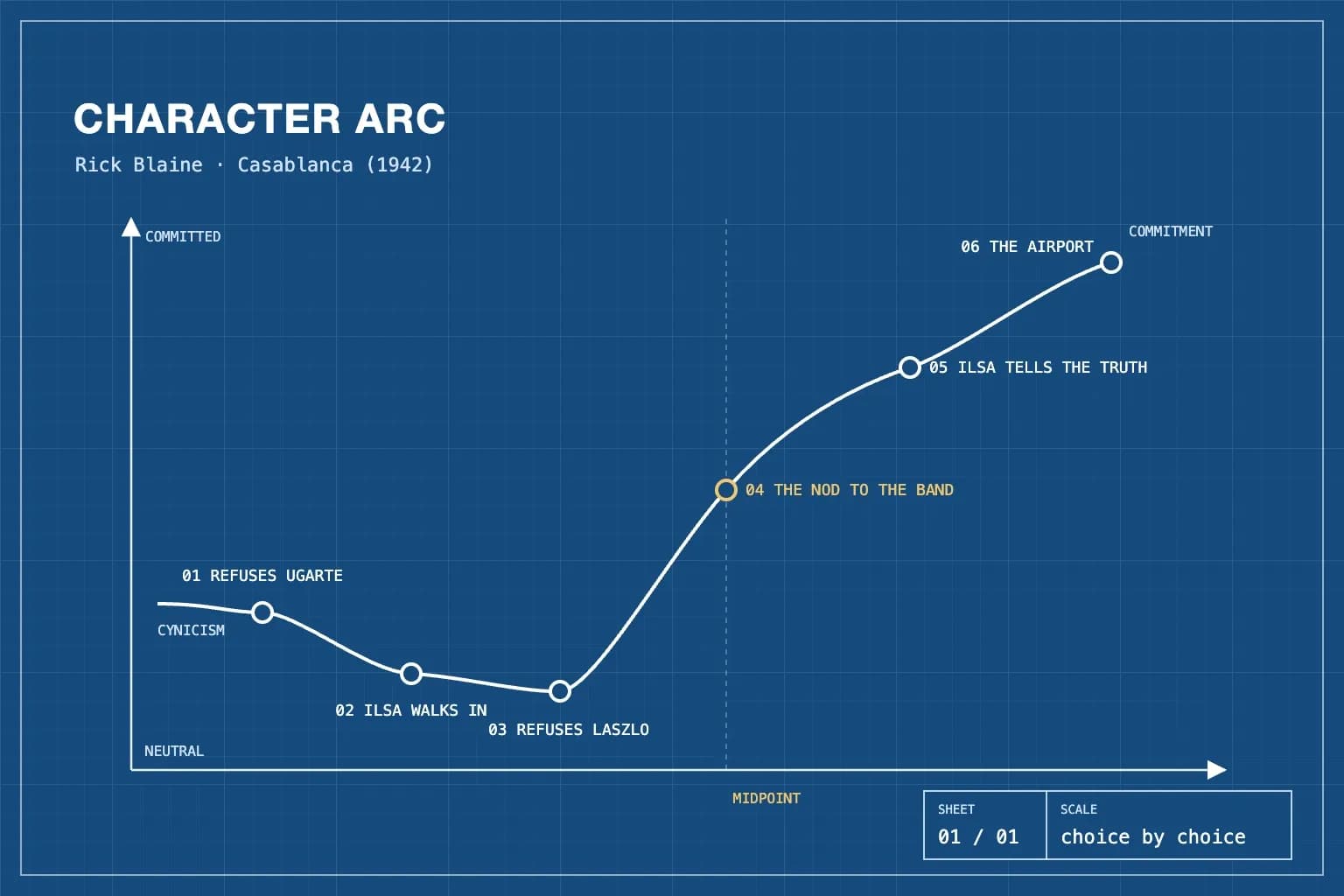
Amélie is not unhappy in an obvious way. She has arranged her life so that nobody can disappoint her, the same defensive logic behind Rick Blaine's character arc in Casablanca, expressed with gentleness instead of cynicism.
What Amélie wants vs. what she needs
What Amélie wants, once the story begins, is to make other people happy, secretly and on her own terms. She wants to arrange their lives like a director arranges a scene: control the timing, stay hidden and watch the result from a distance.
What she needs is the opposite. She needs to step out from behind the camera and let someone see her, which means accepting the possibility of rejection. Every scheme that works for someone else feeds her want and leaves her need untouched. Our post on character motivation explains how want and need pull against each other.
The inciting incident: the box in the wall
On the night the news of Princess Diana's death breaks, a startled Amélie drops a perfume stopper. It knocks a tile loose in her bathroom wall, and behind it she finds a metal box of childhood keepsakes hidden by a boy who lived in the apartment decades earlier.
She makes herself a promise: she will find the owner and return the box, and if it makes him happy, she will devote herself to helping others. With help from the concierge and her reclusive neighbor Raymond Dufayel, she tracks down Dominique Bretodeau. She leaves the box in a phone booth, rings the phone as he walks past, and then watches him open it. Moved to tears, he resolves to reconcile with his estranged daughter and to meet the grandson he has never seen.
This is a textbook inciting incident: an accident that gives the protagonist a goal. Notice what kind of goal it is. Amélie changes a stranger's life without ever introducing herself, and the experience thrills her. The event that launches her arc also confirms her flaw.
Key turning points
Amélie's arc moves through a series of choices, and the early ones all follow the same pattern: help from a distance, stay unseen.
- She guides a blind man to the Métro. She describes the street to him in a rush of detail, then disappears: pure anonymous giving.
- She plays matchmaker and avenger. She brings together her hypochondriac co-worker Georgette and Joseph, a jealous regular at the café, and she wages a campaign of pranks against Collignon, the greengrocer who bullies his assistant Lucien.
- She sends her father traveling. She steals his garden gnome and has a flight attendant friend mail him photos of it in front of landmarks around the world.
- She forges a letter of love. She convinces the concierge, Madeleine Wallace, that the husband who abandoned her sent a final loving letter before his death.
- She meets Nino. Nino Quincampoix collects discarded photos from photo booths and pastes them into an album. When he drops the album in the street, Amélie keeps it.
- She hides when he arrives. She leads Nino around Paris with clues and arranges a meeting at the café, then loses her nerve and pretends not to be the woman he is looking for.
- She opens the door. After a final push from Dufayel, she stops waiting and lets Nino in.
Until the last two beats, Amélie never risks anything personal. She is always the director, never the one on screen.
The midpoint shift: Nino's album
In our reading, the midpoint arrives with Nino's photo album. It is the first time her own heart is involved.
Instead of simply returning the album, she turns it into a treasure hunt across Paris, with chalk arrows, phone calls and disguises. The game lets her get close to Nino while staying hidden, so the strategy that worked for Bretodeau is now being used to avoid love.
From here on, the question is no longer whether Amélie can make others happy, but whether she can let herself be happy.
The lowest point: losing Nino before she has him
When Nino finally comes to the café, Amélie freezes and denies who she is. Her colleague Gina, protective of her, questions Nino on her behalf, and a remark from Joseph leads Amélie to believe Nino has gone off with Gina. Her hiding has cost her the one thing she wanted for herself.
Jeunet stages this low point with quiet precision. Amélie goes home and bakes a plum cake alone, slipping back into fantasy, the old refuge. When Nino later rings her doorbell, she does not answer. The flaw is at full strength: given a real chance, she chooses safety.
The final transformation: opening the door
The arc turns on Dufayel. The old painter, called the Glass Man because his brittle bones keep him shut inside his apartment, has left a videotape for her. In it he tells her not to let this chance pass and insists that, unlike him, she is not made of glass and can take life's knocks.
Amélie runs to the door and finds Nino standing there. The reunion is almost wordless: she pulls him inside and kisses him. The film ends with the two of them riding his moped through Paris. For the first time, Amélie is not arranging a moment for someone else. She is inside one.
Helping others as avoidance: the flaw hidden inside the virtue
Amélie's flaw and her virtue are the same behavior seen from two angles. Her schemes really do improve people's lives, and they also let her feel connected without ever being exposed.
The film makes this explicit through Dufayel's painting. For twenty years he has copied Renoir's Luncheon of the Boating Party, and he has never captured the girl drinking a glass of water, who sits among the party and yet seems apart from it. As the two of them talk about her, Amélie projects her own loneliness onto the figure, and Dufayel uses the girl to steer the conversation back to Amélie herself. The painting lets him say what she cannot hear directly: that she prefers imagining connections to making them.
A flaw that looks like a strength creates sympathy and tension at once: we love Amélie for her generosity and worry about her because of it. For more ways to build flaws that drive a story, see our guide to character flaws in screenwriting.
How the film shows the change
- A mentor who mirrors her. Dufayel is physically trapped by his bones, while Amélie is emotionally trapped by her fear. He is the secondary character who embodies the arc's warning: stay hidden long enough and you will become him.
- Visual metaphors. When Nino leaves the café after she has failed to speak to him, Amélie literally collapses into a splash of water on the floor. The film externalizes feelings she cannot voice.
- Repetition with variation. Phone booths, notes and hidden objects recur. With Bretodeau they help someone else; with Nino they keep him away; at the end she gives them up and opens the door.
Three positive arcs compared: Amélie, Rick and Chihiro
Positive change arcs share a shape, but the flaw at the center changes everything. Compare Amélie with two other characters in this series.
- Amélie (Amélie, 2001): her flaw is fear disguised as generosity. She changes when she lets someone see her and receives instead of only giving.
- Rick Blaine (Casablanca, 1942): his flaw is cynicism built on a wound. He changes when he chooses a cause larger than himself, at the cost of the woman he loves.
- Chihiro (Spirited Away, 2001): her flaw is the fearful dependence of a child. She changes through work and responsibility in the spirit world, as we explore in our analysis of Chihiro's growth.
All three begin protected and end exposed. The difference is visibility: Rick's coldness and Chihiro's sulking are obvious, while Amélie's fear hides behind charm, which is why her arc needs Dufayel as a mirror.
What screenwriters can learn
- A likable protagonist can still have a deep flaw. Look for the fear behind your hero's best quality.
- Let the inciting incident reward the flaw. Amélie's first success confirms her habit of hiding, which makes the later reversal more satisfying.
- Give the theme a mirror. A mentor or contrast character who embodies the cost of not changing makes the stakes visible without speeches.
- Use the midpoint to turn the strategy inward. When the same tactic that served others starts to harm the protagonist, the second half gains direction.
- Make the final change an action. Amélie does not announce that she has grown. She opens a door.
To check whether these beats land in your own draft, you can run your screenplay through Poetika to see how its analysis describes your protagonist's arc, turning points and character motivation, then compare that with what you intended.
Try it yourself: give your character a flaw that looks like a strength
Take the protagonist of your current script and work through these steps:
- Write down your character's best quality, the trait readers will like first.
- Ask what that quality protects them from. Generosity can avoid intimacy; loyalty can avoid change; humor can avoid grief.
- Design an early scene where the quality is rewarded, so the habit feels justified.
- Design a later scene where the same quality costs them the thing they most want.
- Find a character who shows what happens if they never change.
- End with a physical choice that proves they have let the shield go.
Next in the series
Continue the series with Chihiro's character arc in Spirited Away, another 2001 heroine who grows by facing the world rather than hiding from it.
FAQ
What is Amélie Poulain's character arc?
Amélie follows a positive change arc. She starts as an isolated young woman who helps strangers in secret so she never has to risk her own feelings. Through her schemes, her friendship with Dufayel and her attraction to Nino, she learns that giving is not enough, and she ends the film by letting someone see her and love her.
What is Amélie's main flaw?
Her main flaw is fear of being seen, disguised as generosity. She arranges other people's happiness from a distance because it lets her feel connected without being exposed to rejection. The flaw is hard to spot because her kindness is real, which is why the film uses Dufayel and his Renoir painting to reveal it.
What is the inciting incident in Amélie?
The inciting incident is Amélie's discovery of a hidden box of childhood keepsakes behind a loose bathroom tile. She tracks down its owner, Dominique Bretodeau, returns it anonymously, and sees how much it moves him. That success launches her mission to help others in secret, and it sets up the habit she must eventually break.
What role does Raymond Dufayel play in Amélie's arc?
Dufayel is her mentor and mirror. His brittle bones keep him shut in his apartment, just as Amélie's fear keeps her shut inside her imagination. Through their talks about the girl with the glass of water in Renoir's painting, and later through a videotape, he pushes her to stop watching life and pursue Nino.