Spoiler note: this post discusses the full plot of Spirited Away (2001), including its ending.
Chihiro's character arc in Spirited Away is a growth arc: a sulky, fearful ten-year-old who hides behind her parents is forced to work in a bathhouse for spirits, and through a series of small, physical acts of courage she becomes a girl who can act for others, keep hold of who she is and walk home on her own. Hayao Miyazaki shows the change almost entirely through what she does, not what she says.
Chihiro never gives a speech about learning to be brave, and no one hands her a magic power. The film puts her in similar situations again and again and lets us watch her answer differently each time. This post follows her arc from the back seat of the car to the end of the tunnel.
What is a character arc, and what is a growth arc?
A character arc is the inner change a character goes through over a story: who they are at the end compared with who they were at the start. For a full introduction, see our guide to understanding character arc, and for more films analyzed the same way, the series hub on character arc examples.
A growth arc, or positive change arc, is the most common shape: the character begins with a flaw or fear, the plot puts pressure on it, and by the end they have outgrown it. Chihiro's flaw is not a moral one. She is simply a child who has never had to rely on herself, and the story takes away everyone she could lean on.
Chihiro at a glance
- Film: Spirited Away (Sen to Chihiro no Kamikakushi), written and directed by Hayao Miyazaki, Studio Ghibli, 2001. It shared the Golden Bear at Berlin in 2002 and won the Academy Award for Best Animated Feature in 2003.
- Who she is: Chihiro Ogino, a ten-year-old girl moving to a new town with her parents.
- Arc type: growth arc, from dependence and fear to self-reliance and care for others.
- Key symbol: her name, which is taken from her and which she has to remember to get home.
According to accounts of the film's development, Miyazaki wanted to make a film for the young daughters of friends, with an ordinary heroine girls that age could recognize. That explains the arc: Chihiro is not chosen or special, so her growth has to come from ordinary qualities pushed to their limit.
Starting point: a child who hangs back
The opening minutes set up everything the arc will reverse. Chihiro lies slumped in the back seat with a wilting farewell bouquet, complaining about the move. When her father wants to explore a strange tunnel, she refuses, then follows only because she is more afraid of being left alone. Inside, she clings to her mother's arm until her mother tells her to let go.
When her parents start eating at an empty food stall, she hangs back and begs them to leave. She is not wrong to be wary, and refusing the food is what saves her. But her way of handling danger is to complain and wait for adults to fix it. Miyazaki builds this with small beats, not one big scene.
What Chihiro wants vs. what she needs
- What she wants: to go home, and later to turn her parents back into humans and escape with them.
- What she needs: to stop depending on others to protect her, to find her own courage and to keep hold of her identity in a world designed to make her forget it.
The two are tied together. She cannot save her parents unless she becomes someone who can act alone, and the bathhouse will only let her stay if she works, so every external task doubles as a test of the inner need.
The inciting incident: her parents turn into pigs
The inciting incident arrives at dusk. Lanterns light up, spirits appear, and Chihiro finds that her parents, still eating, have turned into pigs. The dry riverbed she crossed earlier is now a river, and her own hands are turning transparent.
It is a near-perfect inciting incident for a growth arc because it removes exactly what the character relies on. From here on, nobody will solve her problems for her.
Key turning points
Chihiro's arc moves through a chain of small tests, each harder than the last:
- The bridge. Haku, a boy from the bathhouse, tells her to hold her breath while crossing so the spirits won't notice her. She loses her breath halfway.
- The stairs. Sent to Kamaji, the boiler man, she gets down a steep, rickety staircase in a stumbling rush. She arrives, but fear is still driving.
- Asking Yubaba for work. The witch who runs the bathhouse shouts and threatens. Chihiro keeps repeating that she wants to work there, and for the first time holds her ground against a frightening adult.
- The stink spirit. Given the worst job, she bathes a foul customer, pulls a mountain of junk from its side and frees a polluted river spirit. The bathhouse cheers. Her competence is now visible.
- No-Face's gold. A masked spirit she let in out of the rain starts conjuring gold and swallowing staff. Everyone grabs at the gold; Chihiro refuses it.
The midpoint shift
The midpoint comes when Haku, in his dragon form, is attacked by paper birds and crashes into the bathhouse, badly wounded. Until now Chihiro has acted to survive and save her family. Now someone else needs her.
To reach him at the top of the building, she climbs out of a window and crawls along a narrow pipe on the outside wall, high above the ground. This is the girl who would not walk through a tunnel without holding her mother's arm. From here her goal widens to saving Haku and returning the seal he stole from Zeniba, Yubaba's twin sister.
The lowest point
The darkest stretch comes right after. Haku lies bleeding in the boiler room, No-Face is rampaging through the bathhouse demanding her, and her parents are still pigs.
Chihiro's answer is to give away the only magical help she has: a herbal dumpling the river spirit gave her. She feeds part of it to Haku, who vomits up the seal and a black slug Yubaba used to control him, and the rest to No-Face, who brings up everyone he swallowed and follows her, quiet again. Then she decides to travel alone to Zeniba to return the seal, using old train tickets Kamaji gives her. The low point becomes a choice.
The final transformation
The train ride is the calmest sequence in the film: a train crossing a flooded plain, shadowy passengers, Chihiro sitting quietly with No-Face and Yubaba's son Boh, turned into a mouse. The girl who sulked in the back seat of a car is now travelling alone, by choice, and she is calm.
Zeniba is kind but tells her she cannot solve Chihiro's problems for her, and gives her a hair tie woven by her new friends. Flying home on Haku's back, Chihiro remembers falling into a river as a small child. It was the Kohaku River, and Haku is its spirit. When she says his real name, his scales fall away.
The arc closes with Yubaba's last test: pick out her parents from a pen of pigs. Chihiro looks carefully and says none of them are her parents. She is right, her contract vanishes and she is free. Haku tells her not to look back until she is through the tunnel, and she doesn't.
On the way out, her mother again tells her not to cling, much as she did on the way in. The echo is deliberate. Her parents remember nothing, and on the surface she is a child beside them again. The change is inside her, visible in how steadily she walks and in the hair tie she still wears.
Names and identity: the symbol at the heart of the arc
When Chihiro signs her contract, Yubaba lifts the characters of her name off the paper and leaves one: Chihiro (千尋) becomes Sen (千), which can be read as "thousand." Haku warns her that Yubaba rules people by taking their names, and that someone who forgets their real name can never find their way home. He has forgotten his own.
The film makes this literal. When she finds her friend's farewell card and sees her name on it, she realizes it had already begun to slip away. From then on, remembering her name and growing up are the same task: she has to survive as Sen without letting Sen replace Chihiro. A name that can be stolen, forgotten and given back turns abstract identity into something an audience can follow.
How the film shows growth without speeches
- Repeated situations. Thresholds (tunnel, bridge, stairs, pipe, train) and frightening adults (Yubaba, No-Face, Zeniba) keep returning. Her changing response is the arc.
- Body language. She starts slumped and clinging and ends up climbing, running and sitting still.
- Work. Scrubbing, carrying, cleaning. Competence shown as labor is believable.
- Refusals. Not eating the food, not taking the gold, not choosing a pig.
- Objects. The farewell card, the dumpling, the train tickets, the hair tie each carry a stage of the arc.
- Quiet scenes. The rice balls Haku gives her, which she eats while crying, and the train ride let the audience feel the change before it is tested.
Growth arc vs. fall arc: Chihiro and Michael
Set Chihiro beside Michael Corleone's character arc in The Godfather, and the shape of her growth becomes clearer.
- Starting point: Chihiro is dependent and afraid; Michael is detached from the family business and decent.
- The pressure: both are pulled into a dangerous world by an attack on their parents.
- What the world asks: both must take on a new role inside a powerful, corrupt organization.
- The difference: Chihiro becomes Sen without losing Chihiro. Michael becomes the Don and loses the man he was.
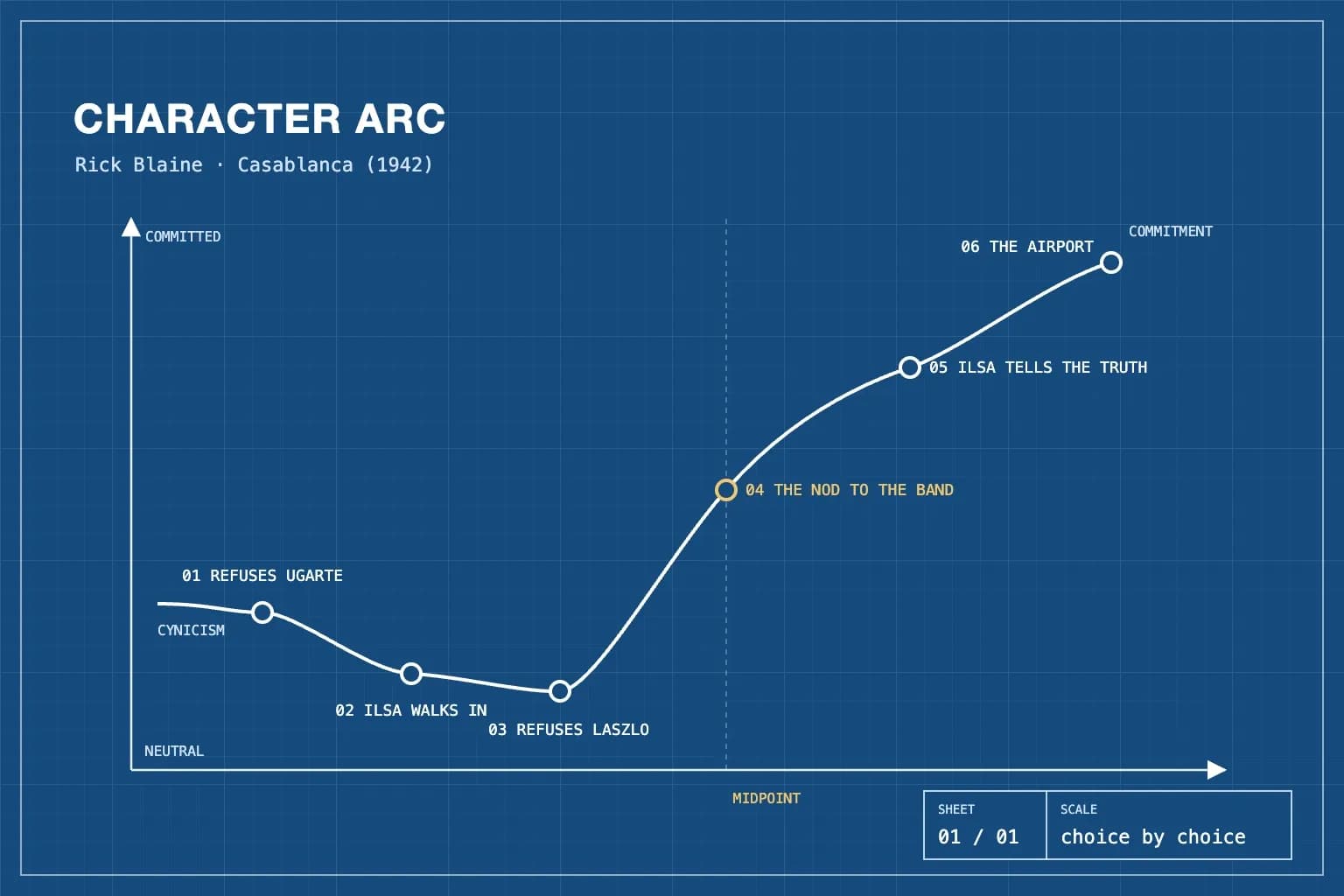
Same pressure, opposite results. It is also why Chihiro sits beside Rick Blaine's arc in Casablanca: both end by acting for others at a cost to themselves.
What screenwriters can learn from Chihiro
- Take away the crutch. Find what your protagonist leans on and remove it in the inciting incident.
- Make the plot the only road to growth. Every task Chihiro completes for her parents is also a step in her inner change.
- Scale the tests. A bridge, then a witch, then a monster, then a journey alone.
- Give the inner change a symbol. A name or object the audience can track makes an abstract arc visible.
- Keep the character's core. Chihiro becomes braver without becoming harder; her kindness survives. Our guide to the elements of a great protagonist covers this balance.
- Trust quiet scenes. The train ride has no conflict, yet it is one of the strongest beats in the arc.
When you rewrite, check whether your protagonist's turning points actually land on the page. A structured read, such as the analysis you get when you upload your screenplay to Poetika, can show where those beats fall and where the character stays the same for too long.
Try it yourself: show growth without dialogue
Write three short scenes for your protagonist, with no dialogue about their feelings:
- A threshold at the start. Put them before a door, path or task and show their fear through action.
- The same threshold in the middle. Raise the stakes. Let them cross it, but badly.
- The same threshold at the end. Let them cross it calmly, or for someone else's sake.
Read the three in a row. If a reader can see the arc without being told, you have the backbone of a growth arc.
Next in the series
The next post looks at a very different positive change arc, an adult whose generosity is a way of hiding: Amélie Poulain's character arc. To compare arcs with characters who barely change, read static vs dynamic characters.
FAQ
What is Chihiro's character arc in Spirited Away?
Chihiro has a growth arc, also called a positive change arc. She starts as a fearful, dependent ten-year-old who clings to her parents and complains. Forced to work in a spirit bathhouse after her parents turn into pigs, she gradually becomes brave, resourceful and caring, saves Haku, frees her parents and walks home on her own.
Why does Yubaba change Chihiro's name to Sen?
Yubaba controls her workers by taking their names. When Chihiro signs her contract, Yubaba takes most of her name and calls her Sen. Haku warns her that if she forgets her real name, she will never find her way home. The name becomes the film's central symbol of identity, which Chihiro must hold on to while she grows.
How does Chihiro know none of the pigs are her parents?
The film never explains it directly, which is part of its strength. By the end, Chihiro has learned to look closely, trust her own judgment and stay calm under pressure. Many viewers read her answer as proof of that growth: she no longer needs anyone to tell her the truth, and she sees through Yubaba's trick.
Is Chihiro a static or a dynamic character?
Chihiro is a dynamic character. She changes in clear, visible ways over the story, from passive and afraid to active and courageous. What stays constant is her kindness and honesty, which is why her change feels natural. Characters such as Yubaba, by contrast, stay largely the same and act as fixed forces around her.
What can screenwriters learn from Spirited Away?
Mainly how to show inner change through action. Miyazaki repeats similar situations, such as thresholds and frightening adults, and lets Chihiro respond differently each time. He ties the plot goal to her inner need, gives the arc a concrete symbol in her name, and trusts quiet scenes like the train ride to carry emotional weight.
Ready to see how your own protagonist's arc reads on the page? Get a structured analysis of your screenplay.