Spoiler note: this post discusses the whole plot of Thelma & Louise (1991), including its ending.
Thelma's character arc in Thelma & Louise is a liberation arc: a timid housewife who cannot bring herself to ask her husband for permission to leave town becomes, over a few days on the road, a woman who makes every important decision herself, including the last one. She starts as the passenger in her own life and ends as the person who tells the driver where to go. The film measures the change through actions, not speeches: from a note left on the counter to a convenience store robbery to the choice at the edge of the canyon.
Ridley Scott directed the film from a screenplay by Callie Khouri, who won the Academy Award for Best Original Screenplay for it. Geena Davis plays Thelma Dickinson and Susan Sarandon plays her friend Louise Sawyer. This post is part of our character arc examples series. Below we break Thelma's arc down beat by beat.
What is a character arc, and what is a liberation arc?
A character arc is the inner change a character goes through over the course of a story, measured by the gap between who they are at the start and who they are at the end. The best-known shape is the positive change arc, in which a character overcomes a false belief or a flaw and ends stronger; our guide to understanding character arc covers the main types.
A liberation arc is a kind of positive arc in which the thing the character overcomes is not only an inner flaw but an outer constraint: a marriage, a family, a rule or a role they have accepted without question. What makes Thelma's version unusual is that her liberation and her destruction arrive together. The arc is positive; the outcome is tragic.
Thelma at a glance
- Film: Thelma & Louise (1991), directed by Ridley Scott, written by Callie Khouri.
- Played by: Geena Davis.
- Arc type: liberation arc, a positive change arc with a tragic ending.
- Starting point: an Arkansas housewife who is afraid of her controlling husband, Darryl.
- Want: a weekend of fun away from home.
- Need: to stop waiting for permission and take responsibility for her own choices.
- Final state: a woman who has found herself and refuses to give that self back.
Starting point: a wife who asks permission
The film opens by cutting between the two friends. Louise, a waitress, is at work in a coffee shop, organized and in control. Thelma is at home, in a mess, while Darryl, a carpet salesman, gets ready for work and treats her like a nuisance. The two friends have planned a weekend at a fishing cabin, and Thelma has not yet asked Darryl if she can go.
She never does. Too afraid of his answer, she leaves him a note instead. That small act sets the baseline perfectly: Thelma wants freedom, but she can only take it by sneaking out. She also packs a handgun, holding it as if it might bite her, and passes it to Louise.
What Thelma wants vs. what she needs
Thelma's want is modest and sympathetic: a couple of days away from Darryl and a chance to have a good time. She is not trying to change her life, only to take a break from it.
Her need is much larger: to stop waiting for a man to tell her what she may do and act on her own judgment, with all the risk that brings. The gap between a modest want and a life-changing need is a classic source of character motivation: the story keeps raising the price of the small thing she wants until only the big change will do.
The inciting incident: the weekend trip
The trip itself opens the door, but the event that turns the road movie into a crime story comes on the first night. Thelma insists they stop at a roadhouse. She dances with a regular named Harlan, and when she feels sick he takes her out to the parking lot and tries to rape her. Louise stops him at gunpoint. As the women back away, Harlan shouts an obscenity at them, and Louise shoots him dead.
It is a textbook inciting incident: sudden, irreversible and outside Thelma's control. Notice that Louise acts; Thelma is the one rescued. Thelma wants to go to the police, but Louise is sure no one will believe them, and decides they will run for Mexico. At this point Thelma is still a passenger, literally and dramatically.
Key turning points
Thelma changes through small steps, each a decision she could not have made at the start.
- Telling Darryl off. Thelma calls home from a gas station. Darryl demands that she come back, and instead of apologizing, she tells him off. For the first time she talks back to the man she was afraid to ask for a weekend.
- Choosing J.D. Thelma takes a liking to J.D., a charming young drifter, and talks the reluctant Louise into giving him a ride. Later he talks his way into her motel room and they sleep together. It is reckless, but it is the first night Thelma does exactly what she wants.
- Losing the money. Louise's boyfriend Jimmy has brought her life savings. Thelma leaves J.D. alone with it, and in the morning he and the money are gone. Louise, who has been holding everything together, falls apart.
- The robbery. Thelma takes charge. She walks into a convenience store and robs it, using the polite, calm routine J.D. described to her the night before.
The midpoint shift
The robbery is the hinge of Thelma's arc. Until now, Louise has made the plans and Thelma has made the mistakes. With the money gone, the roles reverse. Thelma owns her mistake, solves the problem and comes back to the car exhilarated, while Louise sits stunned behind the wheel.
The screenplay underlines the shift by letting other people watch it. In Arkansas, the police, the FBI and Darryl see the store's security footage of Thelma holding up the clerk. To the investigators it is proof she has gone wild; to the audience it is the first time she has looked confident. The question is no longer whether Thelma will get home, but who she is when nobody tells her what to do.
The point of no return
The point of no return comes in New Mexico, when a state trooper pulls them over for speeding. It is Thelma, not Louise, who draws the gun, disarms him and locks him in the trunk of his own patrol car. She even offers him advice on being kinder to his wife.
On the road that night, Thelma tells Louise that something inside her has crossed over and she cannot go back to the life she had. By then the audience has already seen it. Soon after, when a truck driver who has harassed them refuses to apologize, they shoot his fuel tanker until it explodes, acting together as equals.
The final transformation: the last choice
The ending tests the arc with the hardest possible choice. The police and the FBI corner the two women near the edge of the Grand Canyon. Detective Hal Slocumb, the Arkansas investigator who has believed their side of the story all along, tries one last time to talk them into surrendering.
Going back would mean prison and, for Thelma, a return to dependence. It is Thelma who proposes that they keep going. Louise understands, the two women kiss and hold hands, and Louise drives the car over the cliff. The film ends on a freeze frame of the car in midair.
The choice completes the arc by reversing the opening. At the start Thelma could not plan her own weekend; at the end she makes the plan for both of them. For more on closing images like this, see why endings are the hardest thing to write.
Two arcs crossing: Thelma and Louise
The film's structure depends on two arcs moving in opposite directions until they meet:
- Starting point: Louise is controlled, careful and in charge, a woman who keeps her life tidy and a tight hold on her past. Thelma is chaotic, dependent and naive.
- The middle: as the pressure grows, Louise loses control. The money disappears, her plans fail and the past she refuses to discuss, something that happened in Texas, presses in on her. Thelma grows steadier and bolder with every scene.
- The crossing: after the robbery, Thelma becomes the one who reassures, decides and leads.
- The end: Louise lets go of control, and Thelma takes hold of her own life. They meet in the middle, equals for the first time.
How the screenplay shows the change
Khouri's script rarely explains Thelma. It shows her through choices and contrasts:
- Actions that escalate. A note, a phone call, a night with J.D., a robbery, a trooper in the trunk: each step is bolder, so the change feels earned.
- Mirror scenes. In the opening, Thelma cannot face Darryl at all. On the road she tells him off over the phone, and later, when he suddenly sounds sweet, she realizes the police are listening and hangs up. The same relationship, played again, measures how far she has come.
- Borrowed skills. J.D. describes his robbery routine to impress Thelma; she turns it into a survival tool.
- Position in the car. Louise does most of the driving, but by the end Thelma is the one who decides where they go.
Freedom and cost: a positive arc with a tragic ending
Because it ends in death, Thelma's arc is easy to misread as a fall. But an arc is about the inner change, not the external outcome. Thelma ends more honest, braver and more herself than she began. What she loses is her life; what she gains is the self she never had a chance to be.
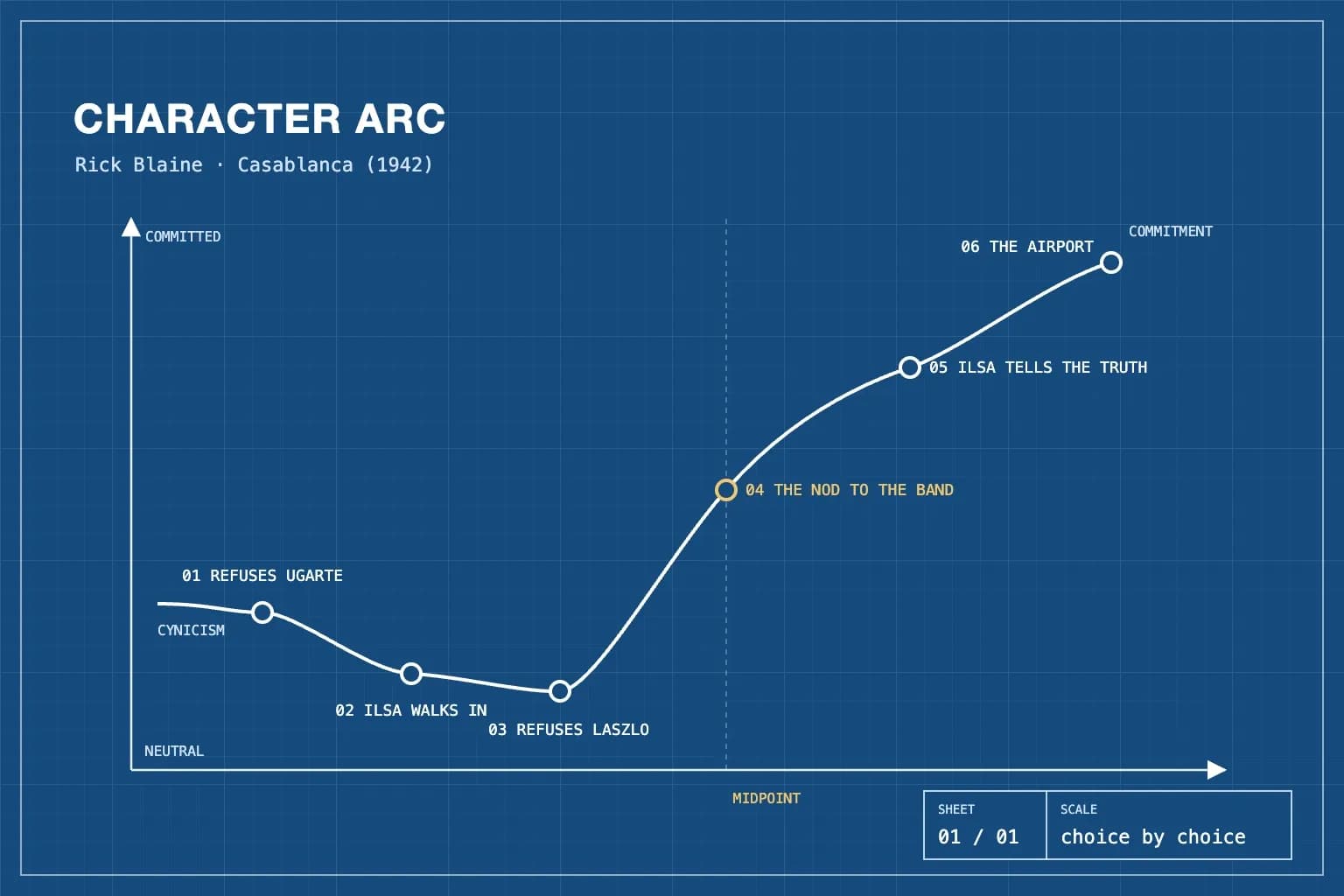
The ending still divides audiences, some seeing defeat and others defiance, because the screenplay refuses to separate the two: freedom and cost arrive in the same moment. For a contrast, compare it with Rick in Rick Blaine's character arc in Casablanca, where a positive arc ends with the hero alive and committed, or with Michael Corleone's character arc, a true fall in which the character gains power and loses himself.
What screenwriters can learn from Thelma
- Set a low, clear baseline. The note to Darryl tells us exactly how small Thelma's world is, so every later act of courage registers.
- Let the inciting incident happen to the character. Thelma is a victim at the roadhouse, which makes her later agency more striking.
- Make the character cause a disaster. Thelma's mistake with J.D. is what forces her to act. A protagonist who causes the problem has to solve it.
- Escalate through choices, not dialogue. The audience believes Thelma has changed because she does things she could not have done before.
- Let the final decision belong to the protagonist. The ending works because Thelma, not circumstance, makes the last choice.
If you are writing a liberation arc and want to see whether your character's turning points read clearly on the page, you can run your screenplay through Poetika for a structured analysis of character, conflict and structure.
Try it yourself: let your character break a rule
Pick a protagonist from your own script, or invent one, and work through these questions:
- What rule does your character obey at the start without questioning it? Write it in one sentence.
- What is the first small rule they break, the equivalent of Thelma's note?
- What mistake of their own forces them to stop being a passenger?
- Which scene proves to the audience that they can now do what they could not do at the start?
- What final choice shows they would rather keep their new self than go back, whatever it costs?
Next in the series
For another woman whose survival comes at a price, read Maria Braun's character arc. The series overview links to every film in the collection.
Wondering how your own protagonist's arc reads to an outside eye? Analyze your screenplay with Poetika.
FAQ
What is Thelma's character arc in Thelma & Louise?
Thelma has a liberation arc, a positive change arc with a tragic ending. She begins as a timid housewife too afraid to ask her husband for a weekend away and becomes a confident woman who makes her own choices. The change is shown through escalating actions, from leaving a note to robbing a store to choosing the film's final move.
When does Thelma change in Thelma & Louise?
The clearest turning point is the convenience store robbery, after J.D. steals Louise's savings. Before it, Louise plans and Thelma follows; after it, Thelma takes the lead. The scene with the New Mexico state trooper, where Thelma holds him at gunpoint and locks him in his trunk, confirms that she cannot return to her old self.
Is Thelma or Louise the main character?
Both are protagonists, and the film is built as a two-hander. Louise drives the plot at first: she shoots Harlan and decides to run. Thelma has the larger inner change, moving from dependence to independence, while Louise moves from control toward letting go. Their arcs cross after the robbery, which is what gives the story its shape.
Is Thelma's arc positive or negative?
It is a positive arc with a tragic outcome. An arc measures inner change, and Thelma ends braver, more honest and more herself than she began. She loses her life, but she does not lose the self she has found. The ending is tragic as an event and triumphant as a character choice, which is why audiences still debate it.
Who wrote Thelma & Louise?
Callie Khouri wrote the screenplay, an original story rather than an adaptation. She won the Academy Award for Best Original Screenplay for it. Ridley Scott directed the film, which was released in 1991 with Geena Davis as Thelma and Susan Sarandon as Louise.