Spoiler note: this post discusses the full plot of The Lives of Others (2006), including its ending.
Gerd Wiesler's character arc in The Lives of Others is a redemption arc: a Stasi captain who believes completely in the East German state is sent to spy on a playwright, and by listening to that man's life he slowly becomes his secret protector, at the cost of his own career. He starts as the system's perfect instrument and ends as a man with a conscience, and he makes the whole journey almost without speaking.
Florian Henckel von Donnersmarck wrote and directed the film, his feature debut. Ulrich Mühe plays Wiesler with a face that barely moves, which is why the arc is worth studying: it is carried not by dialogue but by what he hears through headphones and what he chooses not to write down.
What is a character arc, and what is a redemption arc?
A character arc is the inner change a character goes through over a story: the difference between who they are at the start and who they are at the end. Our guide to character arc in screenwriting covers the main shapes.
A redemption arc is a positive arc that starts on the wrong side: a character doing harm earns a measure of goodness through costly action. Wiesler's redemption costs him his rank, his future and the only identity he has, and the film never lets him be thanked to his face.
Gerd Wiesler at a glance
- Who he is: Captain Gerd Wiesler, code name HGW XX/7, a Stasi interrogator and instructor in East Berlin in 1984.
- What he wants: to serve the state and prove that the playwright Georg Dreyman (Sebastian Koch) is disloyal.
- What he needs: to recognize the human lives behind the files, including the emptiness of his own.
- Arc type: redemption arc, with a high personal price.
- Where he ends: demoted, then a mail carrier in reunified Berlin, holding a book dedicated to him.
Starting point: the perfect instrument of the system
The film opens with Wiesler at his best, by the system's standards. He interrogates a suspect through a sleepless night, patiently and without raising his voice, until the man gives up a name. The session was recorded, and Wiesler plays the tape to a class of Stasi trainees as a teaching example. When a student asks whether the method is inhumane, Wiesler quietly marks a cross next to his name.
Wiesler is skilled, disciplined and sincere. He is not cruel for pleasure; he believes the state is right. He also has no visible private life: a bare apartment, meals alone, and later a prostitute whom he asks, without success, to stay a little longer. His flaw is not a vice he enjoys but a belief he has never questioned, and a true believer has to be shown the evidence one piece at a time.
What Wiesler wants vs. what he needs
Wiesler's goal is clear and external: watch Dreyman, find his disloyalty, file the report. His motivation is duty, and he never questions it.
What he needs, never named, is to feel that other people's lives are real and not material for a file. The surveillance opens a window onto a life full of music, books and love, everything his own lacks. So want and need collide: the better Wiesler does his job, the more that life changes him.
The inciting incident: the assignment to watch Dreyman
Wiesler's inciting incident comes at the theatre. His superior, Lieutenant Colonel Anton Grubitz (Ulrich Tukur), takes him to the premiere of a Dreyman play, and Wiesler, watching the playwright through opera glasses, suggests he should be watched. Grubitz passes the idea to Minister Bruno Hempf, and the operation begins.
The detail that matters is the motive behind the order. Hempf does not care whether Dreyman is loyal. He wants him out of the way so he can keep pressuring Dreyman's partner, the actress Christa-Maria Sieland (Martina Gedeck), into a sexual relationship. For a true believer, this is the first crack. Wiesler took the job to protect socialism, and he discovers he is serving a minister's private appetite.
Key turning points
The first intervention
Disgusted by Hempf, Wiesler uses the surveillance wiring to ring Dreyman's doorbell just as Christa-Maria is getting out of the minister's car, so that Dreyman will see her. Spite or a first instinct to set something right, the act is not neutral. Wiesler is no longer only recording the lives below him.
Taking the Brecht
Wiesler slips into the apartment and takes a volume of Bertolt Brecht's poems from Dreyman's desk. We then see him reading it at home, alone. It is the first thing we see him do for himself, and what he chooses is the inner life of the man he is watching.
The sonata
Dreyman's friend Albert Jerska, a director blacklisted by the state, gives him sheet music for a piece called Sonata for a Good Man. When Dreyman learns that Jerska has hanged himself, he sits at the piano and plays it. In the attic, Wiesler listens, and a tear runs down his face. Dreyman then wonders aloud whether anyone who has truly heard this music could still be a bad person.
The midpoint shift
At the midpoint, Wiesler stops observing and starts acting for the people he watches.
In the first, a small boy with a ball asks Wiesler in an elevator if he is really with the Stasi and repeats what his father says about such men. Wiesler begins the interrogator's question, wanting the father's name, then stops and asks the name of the ball instead.
In the second, Christa-Maria is on her way to another meeting with Hempf. Wiesler approaches her in a bar as an admirer of her work and tells her that her audience loves her for who she is, so she does not need to sell herself. She goes home to Dreyman instead, and back at his post, Wiesler is visibly happy. His goal has flipped. He was sent to destroy this household; now he is trying to hold it together.
The point of no return
The point of no return is a choice the character cannot take back. For Wiesler it comes when Dreyman decides to write an anonymous article for the West German magazine Der Spiegel about the suicide rate in East Germany, a figure the state has stopped publishing.
To test whether the apartment is bugged, Dreyman and his friends stage a fake plan to smuggle someone across the border. Wiesler hears every word and does not report it. From then on he is not just failing to report; he is inventing. His reports describe Dreyman writing a play for the country's fortieth anniversary, while Dreyman is typing the article on a smuggled typewriter, hidden under a floorboard, whose ribbon prints in red.
The final transformation
When the article appears, Christa-Maria, dropped by Hempf, is arrested and names Dreyman as the author, but a first search finds nothing. Grubitz then hands the interrogation to Wiesler, partly as a test of his loyalty. Wiesler faces her across the same kind of table we saw in the opening scene, and she tells him where the typewriter is hidden.
The climax mirrors the opening. The interrogator's skill that defined Wiesler is used one last time, and then he does what the old Wiesler never would: he reaches the apartment ahead of the search team and removes the typewriter. When Grubitz's men lift the floorboard, the space is empty.
The rescue is not clean. Christa-Maria, believing Dreyman will learn of her betrayal, runs into the street, is hit by a truck and dies in his arms. Grubitz, unable to prove anything, sends Wiesler to Department M to steam open letters in a basement. His redemption has saved Dreyman and cost him everything he was.
Surveillance as a story device: how watching becomes empathy
The surveillance is the mechanism of the arc: every tool the state gives Wiesler to control Dreyman exposes him to Dreyman's humanity.
- Listening forces intimacy. Wiesler hears arguments, lovemaking, music and grief. He knows these people better than anyone in his own life.
- Reports force choices. Every shift ends with a document, which turns an inner change into concrete decisions: what to include, what to omit, what to invent.
This is how films build empathy for a character: by holding them, and us, inside another person's experience until indifference becomes impossible. We start watching a cold man doing ugly work and end up hoping he gets away with his betrayals.
Showing change in a man who barely speaks
Wiesler never explains himself. He has no confidant and no speech about what socialism has become. Every step is shown through behavior:
- Actions instead of declarations: ringing a doorbell, taking a book, leaving a line out of a report, removing a typewriter.
- Reaction shots: much of Mühe's performance happens while he listens, and the film trusts the audience to read a slight change in his face.
- Repetition with a difference: the interrogation at the start and at the climax use the same method for opposite ends.
If a reader cannot point to the scene where a character changes, the change probably is not on the page. That is the real gap between a static and a dynamic character: not how much they talk, but whether their choices shift.
The final scene: recognition without a reunion
After the Berlin Wall falls, Dreyman learns from Hempf that he was fully bugged. At the Stasi Records Agency he reads his file and realizes that agent HGW XX/7 protected him; a red ink smudge on the last report ties the agent to the hidden typewriter. He tracks Wiesler down and watches him delivering post, but does not approach him.
Two years later, Wiesler passes a bookshop window advertising Dreyman's new novel, Sonata for a Good Man. Inside, it is dedicated to HGW XX/7, in gratitude. Asked whether he wants it gift-wrapped, Wiesler answers: "No, it's for me."
The two men never meet, because the arc was always about Wiesler's inner life, not a relationship. The dedication is recognition delivered as indirectly as Wiesler once watched Dreyman, and his last line is the first thing he claims for himself.
Quiet arcs compared: Wiesler, Rick and Chihiro
- Gerd Wiesler, The Lives of Others (2006): from loyal instrument of the state to secret protector, driven by exposure to another man's life, at the cost of his career.
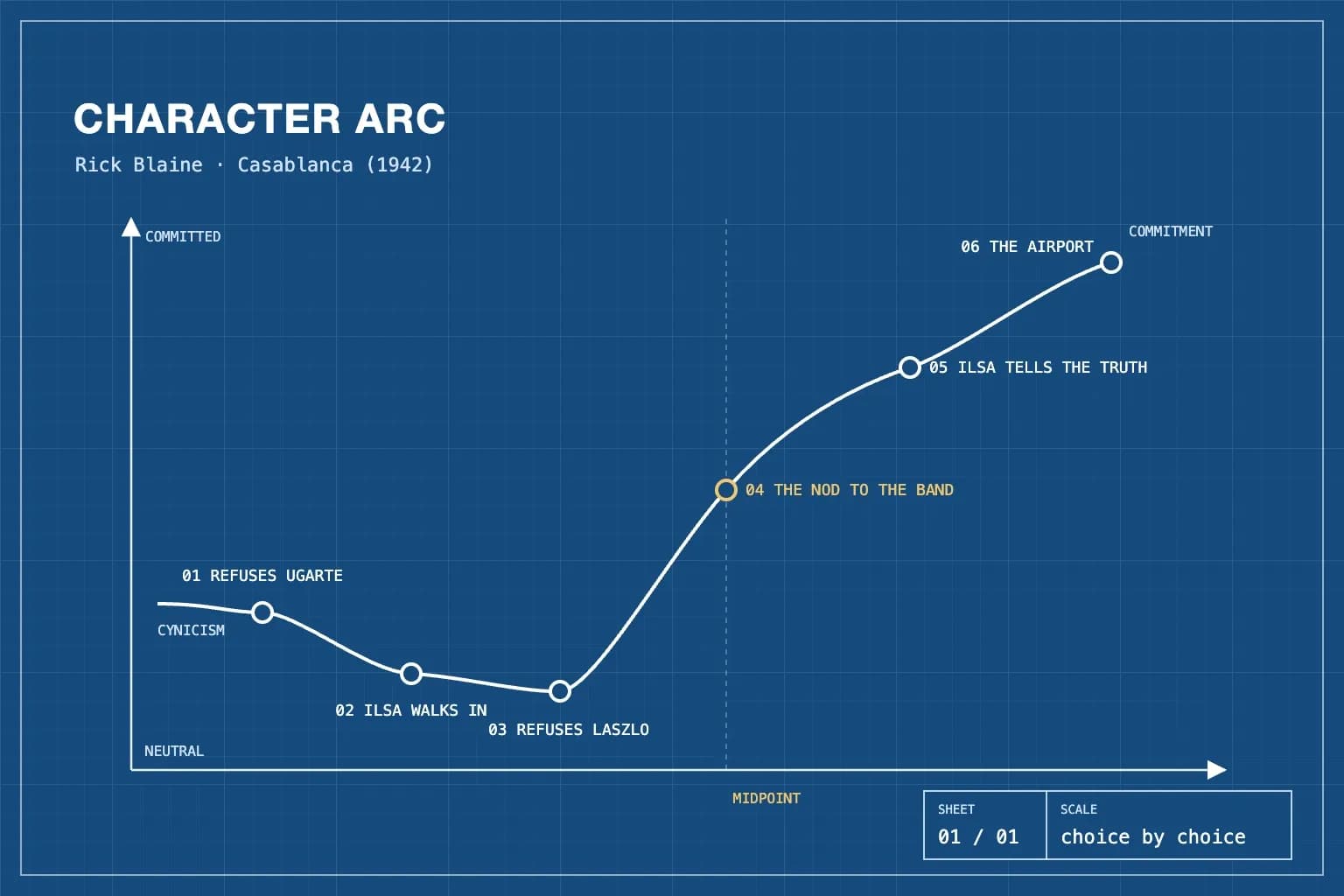
- Rick Blaine, Casablanca (1942): from a cynic who sticks his neck out for nobody to a man who gives up the woman he loves for a cause. See Rick Blaine's character arc.
- Chihiro, Spirited Away (2001): from a sulky, frightened child to a girl who works, remembers and saves others, shown almost entirely through what she does. Read Chihiro's character arc in Spirited Away.
In all three, the final step is an act of sacrifice or service, not a speech. For more, see our character arc examples.
What screenwriters can learn from Wiesler
- Start a redemption arc with conviction, not doubt. A true believer has further to travel, and every crack becomes a scene.
- Let the premise work on the protagonist. Wiesler's job exposes him to the very thing that changes him.
- Turn inner change into objects and choices. Reports, a book, a typewriter, a doorbell: each makes an invisible shift visible.
- Make redemption expensive. If a moral turn costs nothing, readers will not believe it.
If you want to see how your own protagonist's change reads on the page, you can run your screenplay through Poetika, which looks at character development across the script and points out where a turn is announced rather than dramatized.
Try it yourself: change a character through what they observe
- Choose a character with a firm belief about other people, such as a judge, an inspector or a cynical journalist.
- Give them a reason to observe someone closely without talking to them: a file, a recording, a window.
- Write three scenes in which what they observe contradicts their belief, with physical reactions only.
- Write the choice that cannot be undone, and decide what it costs them.
Next in the series
Next in our character arc series: an underdog who goes the distance, in Rocky Balboa's character arc.
FAQ
What is Gerd Wiesler's character arc in The Lives of Others?
It is a redemption arc. Wiesler starts as a loyal Stasi captain and skilled interrogator assigned to spy on the playwright Georg Dreyman. Exposure to Dreyman's life, music and relationships slowly changes him, and he begins falsifying reports and finally hides the evidence that would convict Dreyman, which ends his career.
Why does Wiesler change in The Lives of Others?
The film suggests several causes rather than one. He learns the operation serves a minister's personal desire, not the state. He is moved by art, especially the piano sonata Dreyman plays after a friend's suicide. And listening to a life full of love and friendship exposes the emptiness of his own.
What does the ending of The Lives of Others mean?
The ending shows that Wiesler's sacrifice was seen. Dreyman dedicates his novel to HGW XX/7, Wiesler's code name, in gratitude, but never meets him. When Wiesler buys the book and says it is for him, he accepts recognition for his act and, for once, claims something as his own.
Is Wiesler a static or dynamic character?
Wiesler is a dynamic character. His beliefs, loyalties and actions change fundamentally over the film, from serving the surveillance state to secretly defying it. What makes him unusual is that his change is shown almost entirely through small actions and reactions, with very little dialogue explaining what he feels.
Who plays Gerd Wiesler in The Lives of Others?
Ulrich Mühe plays Wiesler. The film was written and directed by Florian Henckel von Donnersmarck and released in Germany in 2006. It won the Academy Award for Best Foreign Language Film, and Mühe's restrained performance is widely seen as central to how the character's quiet transformation reads on screen.